· Dana Whitfield
Why Jumping Spiders Build a Hammock (Nest): Where They Put It and When to Worry
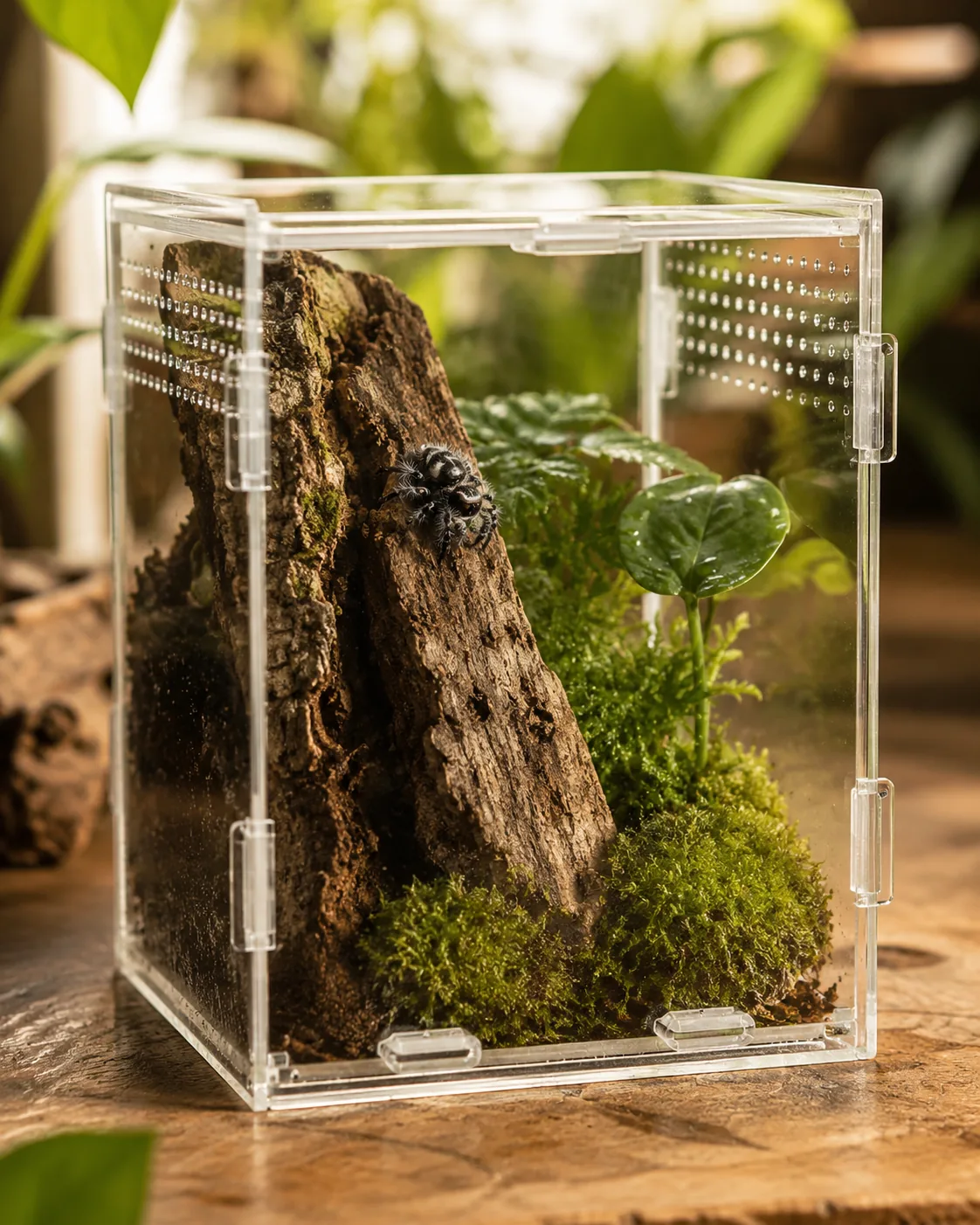
New keepers meet the hammock in the first week: the spider disappears one afternoon, and by morning a white pouch of silk is wedged into a top corner with the animal inside. This guide takes the animal's side: what the structure is for, where it goes, what happens inside it, and the short list that does call for a closer look. One note on words: the silk nest in this guide is the spider's own construction. ArachNest is the name on the enclosure it gets built in.
What is the hammock a jumping spider builds?
A web is a trap; a hammock is a room. Salticids carry some of the sharpest eyes in the invertebrate world and stalk prey in daylight — the reason feeding happens at the front with tongs, as our care guide describes — so their silk goes into anchor lines across the decor and into this one structure.
The most detailed description we know of is Jackson's field-and-laboratory study of one North American species, Phidippus johnsoni, in the Journal of Arachnology: 69 nests occupied by adults, the same layout nearly every time — a straight tube, a door at each end, white silk around a hollow interior, two to three times the spider's own body length.
Nest length relative to the spider's own body length, measured on 69 adult Phidippus johnsoni nests in the field
The silk thickens with time: nests spiders molted or laid eggs in were almost always fully opaque, and in the laboratory that density took days to a few weeks. A translucent hood turning solid white over the following days is doing what hammocks do.
Why do jumping spiders build one at all?
Jackson's sunrise censuses found every spider inside a nest, and in the laboratory spiders drifted into their nests through the afternoon until, by lights-out, virtually all were in. A jumping spider that vanishes at dusk and reappears on its cork in the morning is keeping a schedule, not hiding from you.
Molting carries the highest stakes: a spider mid-molt cannot defend itself, and the study measured the shutdown — sealed in for roughly six days before a molt and two after it, the latter, in Jackson's reading, while the new cuticle hardens.
Average time Phidippus johnsoni stayed inside its nest before and after a molt in Jackson's laboratory colony (95 and 156 molts observed)
Eggs are the third. A mated female of this species laid up to five batches after a single mating, about a month apart, and the two females Jackson kept in terraria raised every batch in one nest, occupied for six to seven months.
Where in the enclosure do they put it?
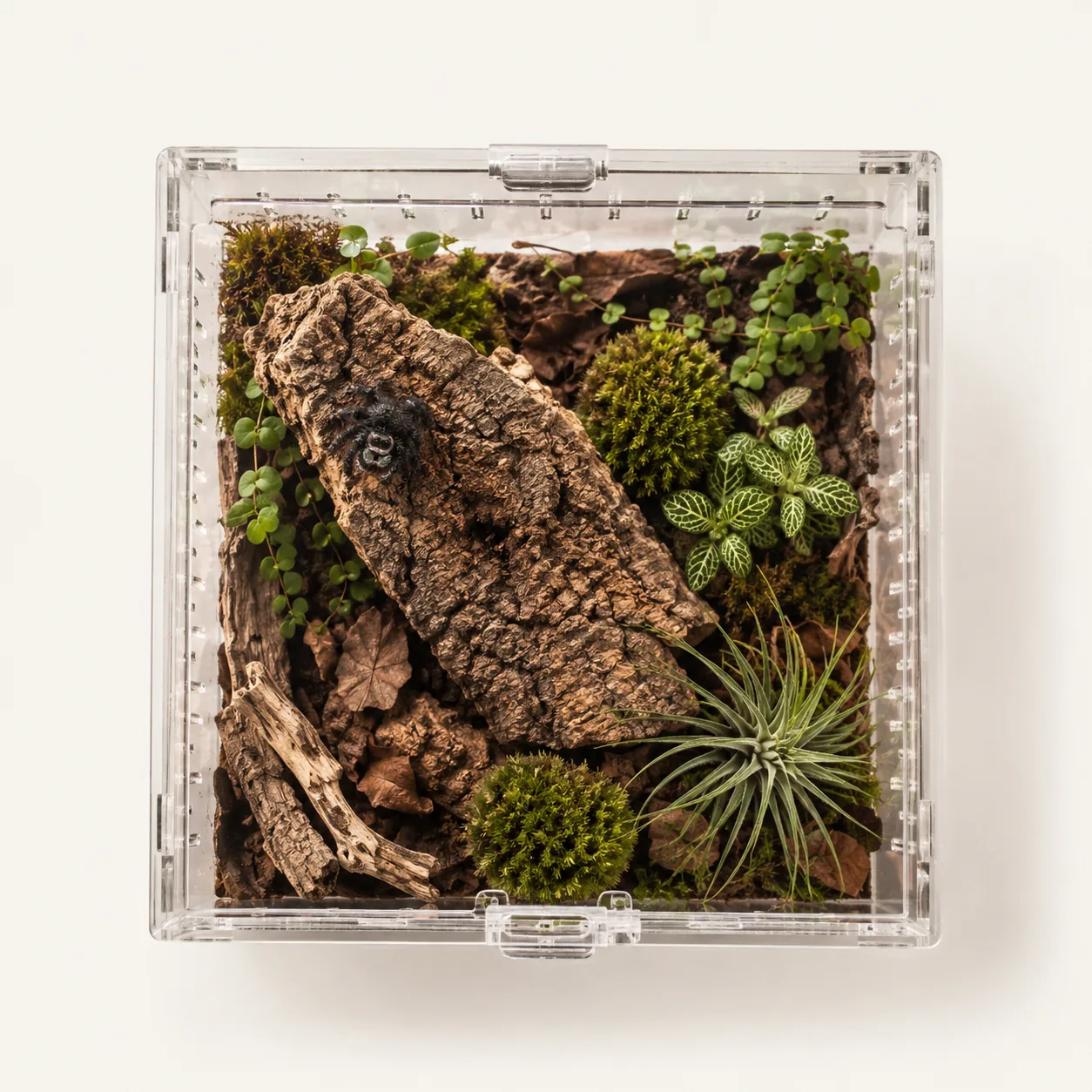
The corner preference is the study's most useful fact for anyone arranging an enclosure. Jackson's laboratory spiders built 85% of their nests in corners, and his explanation bears keeping: a corner gives the nest enough three-dimensionality to attach to and approximates a concealed spot on a rock — in the field, nests sat against rock sides and under loose bark, screened by grass or another rock.
Laboratory nests built in a corner where two (35%) or three (50%) walls met, out of 241 Phidippus johnsoni nests
What a captive jumper is choosing is a corner and cover, and in a clear box on a desk the spot that offers both is the top one, under the lid. Keepers see the same instinct on cork bark — the hammock goes into the seam where bark leans against a panel — which is why our terrarium setup guide asks for an enclosed hiding spot, not a bare cube.
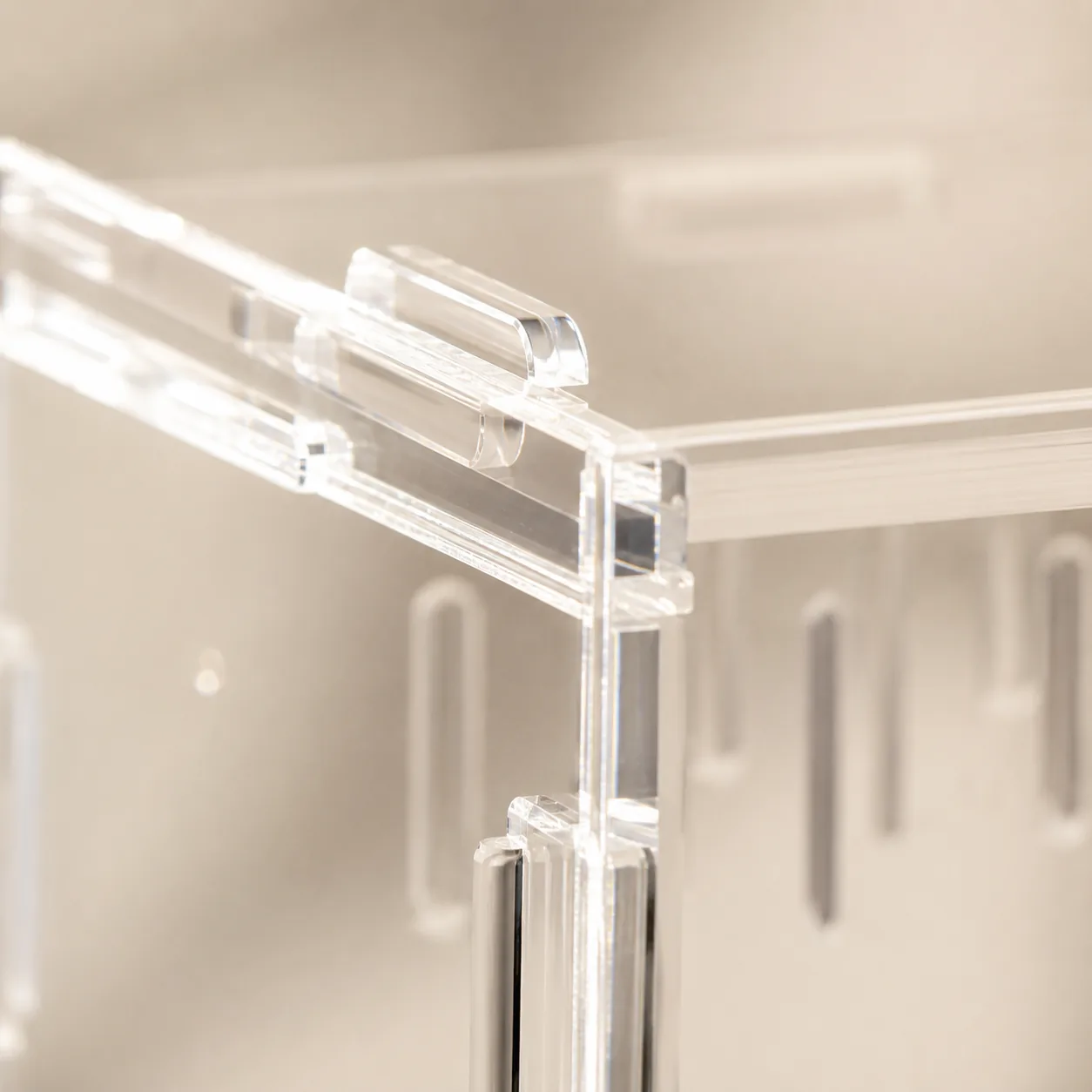
That placement is the case for height, which our enclosure size guide makes from the sizing side: a molt in a low, crowded corner next to damp substrate is the failure keepers most often describe. The 12x12x20cm and 15x15x25cm formats in our jumping spider enclosure line leave a clear column above the decor for that reason, and their cast-acrylic panels meet at true corners on every side. A hammock on the lid is not a mistake to correct: the lid lifts one-handed on magnets, and nothing slides across the silk.
What happens inside during a molt or egg-laying?
The keeper's response to both is nothing. The refusal to eat that precedes it is in our care guide; the molt that appears afterwards, and why it never goes in the bin, is in our cleaning guide. A hammock with an exuvia still inside is a record, not dirt.
An egg sac reads differently: the silk thickens into a distinct mass, the female sits on or beside it and leaves only briefly — Jackson's terrarium females returned to the nest by evening every time. A single pet female can still lay, fertile or not (one of Jackson's mated females followed two fertile batches with an infertile one), and either way the sac stays with her and the lid stays closed. Afterwards, expect rebuilding — the study recorded old nests abandoned, second chambers added and nests reused by other spiders — so two hammocks in one enclosure is a history, not an infestation.
What is normal, and what does a settled spider look like?
The first hammock is the milestone: in the laboratory, 89% of spiders placed in a clean cage built a nest within 24 hours. That first nest is often temporary — Jackson's terrarium females each abandoned their first-evening nest and built their lasting nest four or five days later — so a spider that relocates in the first week is refining, not rejecting.
Spiders that built a nest within 24 hours of being placed in a clean cage, out of 322 Phidippus johnsoni in the laboratory
From there the pattern is fidelity. Marked spiders in the field kept the same nest site for weeks and came back after excursions of up to 1.2 m. A pet jumper does the same at desk scale — out onto the cork, up the vent panel, back to the same corner by evening — the show the clear panels are for; one review on our reviews page calls the enclosure "crystal clear once the protective film is removed."
| What you see | What it usually means | What to do |
|---|---|---|
| Thin silk hood in a top corner on day one | First nest — settling in | Nothing; it may be rebuilt within the week |
| Spider closed in, not feeding, dull in color | Premolt | Stop offering prey; take out any loose feeder; keep the lid closed |
| Denser, rounder mass inside with the female on it | Egg sac, fertile or not | Leave it; keep misting one side; feed at the front only when she is out |
| Hammock built against the lid | The best three-surface corner on offer | Open slowly and briefly; never peel the silk off |
When should you worry about the hammock?
Start with what is next to it; opening the hammock is the one action with no upside. A cricket left wandering with a spider that has closed itself in is the classic loss keepers report, and the one reason the lid opens during premolt: the feeder comes out with long tongs, nowhere near the silk. Mold is the second. White fuzz under or on the silk points at damp, and the fix is the environment — less misting, a vent-row check, then the substrate patch if it keeps returning, the triggers our cleaning guide works from. A hammock built low on the substrate reads the same way, usually condensation on the upper panels or a heat source above. Placement is on our spider tank page, humidity on the spider habitat guide.
Then the animal. A spider closed in for well beyond the week-and-a-bit the study describes, or out with legs curled under the body, unable to grip the panel, or with a molt visibly stuck to it, is past what a keeper can read through the acrylic. That is the threshold to ask for help — an experienced keeper community for the species, or an exotic-animal veterinarian — rather than to open the hammock. None of the timings above are promises: they describe one species in one study and amateur keeper practice, and individual spiders vary. A hammock is never a reason to clean, move the spider or rearrange the decor it is anchored to.
Put together: the hammock is the first thing a jumping spider builds — bedroom, molting chamber and, for a female, nursery — and it goes into the best covered corner on offer, which is why an enclosure's height, corners and lid decide where that is. Clear cast-acrylic panels, a magnetic lid that opens one-handed and laser-cut ventilation keep it visible, undisturbed and dry — the brief behind our jumping spider enclosure line, in three sizes matched to the animal.
Average rating across 130 verified buyers of the ArachNest acrylic enclosure line
— ArachNest verified buyer data, 2026
Everything above reflects care practice shared among amateur keepers and one published field study of a single species, not veterinary guidance or a welfare guarantee. Species, individual temperament and your room's conditions all move the answer, so cross-check a care sheet for the species you keep. How we reach recommendations like these is on how we test.

Dana Whitfield · Invertebrate Keeper & Enclosure Reviewer, 6 yrs
Dana has kept and reviewed invertebrate enclosures for six years, testing lid security, ventilation, and build quality across dozens of acrylic and glass setups.
Jumping spider hammock FAQ
Why is my jumping spider making a hammock?
Because that is where a jumping spider spends the night, molts and, if female, lays eggs. Salticids hunt by sight in daylight and shelter in silk when they cannot, so a new spider spinning within a day of arriving is settling in, not stressed.
Where do jumping spiders build their nest in an enclosure?
In a corner, nearly always — in a keeper's enclosure usually a high one: the top of a panel, against the lid, or the seam where cork bark meets a wall. In Jackson's laboratory, 85% of nests went where two or three walls met.
How long does a jumping spider stay in its hammock to molt?
Days, not hours. In a laboratory colony of Phidippus johnsoni, spiders sat sealed inside their nests about six days before a molt and about two days after it. A spider that has stopped feeding and closed both doors is doing exactly that.
Should I remove an old jumping spider hammock?
No. An abandoned hammock stays unless mold has taken it, and an occupied one is never touched: spiders reuse old nests, add chambers and move into nests other spiders built. Our cleaning guide lists the few things that do come out.
Related pages
Sizing the corner a hammock needs? See the enclosure size guide. Setting up from empty, hiding spot included, is in the terrarium setup guide. The material those corners are made of is on acrylic terrarium.